Kindle Nation Daily UK Results

So, some 24 hours ago, my Kindle Nation Daily UK  sponsorship went online.   The results are in!  The grand total of new UK sales is…

… none. I’ve had 4 sales until now, which seems rather normal compared to my US sales, but none from the UK since the weekend.  There has been a nice little boost to my US sales in the last 24 hours, although it’s a little hard to tell exactly since in that time my book has also been featured on Indie Books Blog, as well as an interview at Kindle Author.  It’s actually rather annoying that these last two free promotions ended up timing out with my Kindle Nation UK sponsorship, since I can’t really tell what’s causing what.

Anyhow, I’m pleasantly surprised by the affect on my US sales, and I’ll see how long that lasts.  However, as it stands now, the UK sponsorship through Kindle Nation Daily seems quite overpriced.  That’s just my experience, at least.

If someone reads this who’s had better success with Kindle Nation Daily UK, please leave a comment!

Five weeks in review

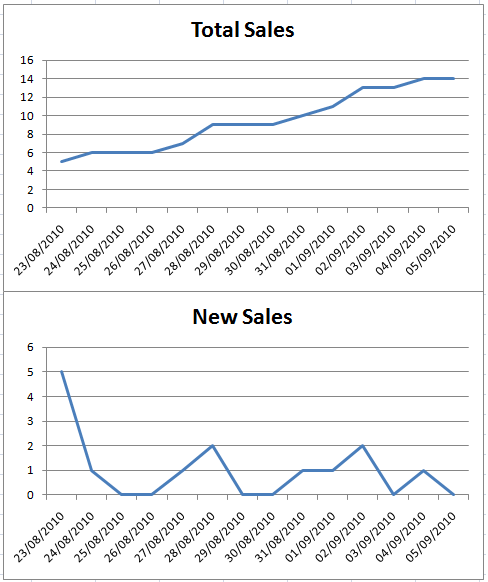
So, as mentioned in my last post, I received a big boost in sales early in the week in which I attribute almost completely to an active discussion in the Amazon Customer Discussions for a few days.  Over these last few days the discussion has pretty much dried up, and the effect on sales it quite apparent:

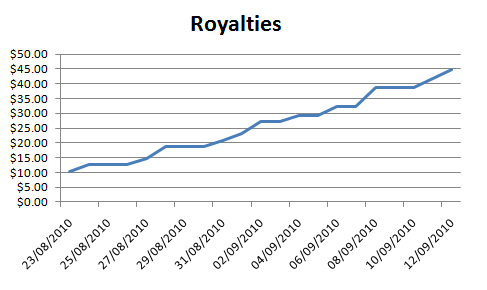
And the effect on royalties just as obvious:

Thanks (I believe) to those discussions, I had more sales last week (especially in the first few days) than I did in the week when my book was priced at 99 cents.   Like I wrote earlier, that single discussion made a bigger impact on sales than anything else I’ve done.  But, these last few days things are quieting down.

Tomorrow (Monday), I have my paid sponsorship for Kindle Nation Daily UK.  Most of what I’ve read about the UK sponsorship leads me to believe I should count myself lucky to just get a few sales.  If this is the case, then the UK sponsorship is way overpriced.  I’ll let you know on Tuesday with a detailed post on this.   It seems that UK Kindle sales at about 1/10th of the Amazon.com site’s sales, so I guess I hope to get a whopping 5 sales from that sponsorship.   At 35% royalties, that’s… not much.  We’ll see.

Don’t Discount the Discussions

The Amazon Customer Discussions, that is.  On Sunday evening, I posted a new thread, promoting my book and the fact that I was lucky enough to get a nice review from J.A. Konrath.  It was fairly shameless promotion, but when you’re doing stuff online, it’s a lot easier to be shameless.  The thread is here (and please join the conversation!).  Well, I was also lucky enough to inadvertently start and argument on the board about whether or not an author should be promoting a book there (I think slightly more people were in favour), and this had the side-effect of keeping my topic on the first page, garnering a lot of hits from people.  Although I don’t believe it’s possible to view how many views a customer discussion has had, every time a volley of posts came in, I sold a few copies.  Many people in the thread said they bought a copy because they found the posts funny.

I think until now I’d discounted how valuable the Amazon Customer Discussions are.  I can honestly say that they have led to more sales of my book than any other single thing I’ve done.  While I’ll update the sales on the weekend, I’ve had a better start to the week than I did when I dropped the price to 99 cents.  I’m sure there’s some residual effects from having a couple of positive reviews on blogs, but, again, when there’s no action on my thread, not much happens.  If a number of people start replying to me and each other, I sell one, two, maybe three copies in short period of time.  It’s taken me by surprise.

Ironically, the argument that began in my post began because some people didn’t want authors clogging up discussions with their promotions.  So, I’d feel bad about writing this post, except that I know that not a lot of people are going to read this, so I’m not afraid of causing a flood of new postings at Amazon…

4 Weeks’ Sales in Review

So, as alluded in my first month’s review, changing the price to 99 cents made a very noticeable change in sales.  You don’t have to be an expert with reading graphs to see what happened:

I think you can tell when the price dropped to 99 cents.  Still lots of fluctuations, including no sales at all last Wednesday.  The highest spike also corresponds with the day that Whatley Tupper was featured on Spalding’s Racket.  I’ve heard others say that when they drop to 99 cents that their sales spike and then cool after a few days, and I can certainly attest to that.

In terms of royalties, of course, they slowed, even though I nearly doubled my total sales in a single week:

But, of course, anyone who sets their price at 99 cents shouldn’t be thinking about royalties.  (I will be honest about this: I do want to crack the $100 mark sooner than later, because that’s when a non-US citizen breaks the threshold to receive a royalty cheque from Amazon.  It will be the first ever royalty cheque I’d ever had, and I might just want to frame it).  Pricing at 99 cents is about exposure, and I’ll admit that I was taken by surprise with how much of a difference it made.  I’ll definitely try another one-week 99 cent sale again in another month (probably November) to see if something similar happens.

But, for the next few weeks, I want to leave the price alone at $2.99.  I’m curious if I’ll notice any difference in sales compared to the last time it was at this price.  Then, I was averaging about 5 sales a week, but I’ve received a couple of nice blog reviews since then, as well as an Amazon review from J.A. Konrath.  You know that I’ll update you with all the exciting Excel graphs next Sunday.

The First Month in Review : What Worked, What Didn’t

I started this blog because I read that authors who want to go the self-publishing route need to start a blog.  But, what to write about?  Really, what do I have to say that others will want to read?

So, I decided to focus on all the details, the sales and such, of publishing my first ebook.  Before I published Whatley Tupper on Amazon (and saying I ‘published’ it sounds so much more involved than in reality: I clicked a button), I couldn’t find much information on how many books new authors sell, and what to expect.   So, that became the focus of my blog.  And now that it’s been a month since I dived into this, I want to relay some of the things I think worked, and what didn’t.

What worked best?

A few things stand out.  Checking in regularly to Kindleboards, DTP Community, GoodReads, Amazon Community Discussions, and most recently MobileRead forums definitely helps, and I know I’ve got a few sales through each of those avenues.  The Author-Tag exchanges are also useful at both Kindleboards and DTP Community.

Making it cheap.  I’ll discuss this in more detail tomorrow (when I’ll update the sales and royalties graphs), but putting my book down to 99cents made a huge difference in sales.  I still don’t think I’ll keep it there for long (for reasons I discussed in earlier posts), but if you want to get your book out there faster, put it at 99 cents, at least for a week or so.  If I could do this again, I think I’d start at 99 cents just to get more copies out.

Smashwords free coupons.  I know I’ve received at least a couple reviews through this, and I’m sure more will come along at later times.  Personally, this is all I use Smashwords for, the ability to give out free copies of your book.   It also allows you to download the Kindle-ready book file which you can attach to emails to prospective online reviewers.

A professional looking cover.  People really do judge a book by it’s cover, especially with ebooks, I think.  The spray bottle I made in 20 minutes appealed to my minimalist tendencies, but a cover for a book needs to be bold and clear even in a thumbnail.

Getting reviews.  Unless you’re getting friends to write overly glowing reviews, this takes time.  Hence the 99 cent route is useful, as well as Smashwords.

Spalding’s Racket.  I was featured when my book cost only 99 cents, and that day was the best day of sales I’ve had yet.

Getting lucky.  First, get your mind out of the gutter.  I’m referring to J.A. Konrath releasing his own choose your own adventure style book just this week, which lead to him writing a review for Whatley Tupper (which I plan on flaunting shamelessly anyway I can).  This had nothing to do with anything I did.  It’s just fortuitous timing.

What didn’t work?

Rushing into this too quickly.  I really should have waited a couple more weeks before clicking publish.  The earliest versions of Whatley Tupper had many typos, formatting errors, and malfunctioning hyperlinks.  I’ve been writing for more than a decade, and this is no time to get impatient.  I think I’ve been lucky in that no one who purchased one of the earliest copies ever wrote a scathing review (at least, yet), but this easily could have been avoided.  Considering the bad taste a lot of self-published work is leaving in some readers’ mouths, I don’t want to be part of the problem.  And I do not feel any resentment towards these people who trash self-published books for their amateurish quality.   If people are paying for something, even if it’s just 99 cents, it should be professional in quality.

Raising the price to $4.49.  Yeah, maybe there was a slight improvement in royalties, but I was only getting out a book every other day.  An unknown author will never grow his/her base that way.  Stick to $2.99, max, while no one knows you.  This isn’t about making royalties, not at this stage, at least.

Facebook.  But that’s just me, I’m sure.  I never used it before, instead enjoying being one of the last holdouts as if it makes me a better person (it does).  And, being a high-school teacher, I don’t want to have my own facebook account since that just seems like it’s not going to lead somewhere positive.  Perhaps I’ll learn more about the potentials of this.   Right now, it’s not doing anything for me.

What’s next?

I think the next month could be significant.  I have a paid sponsorship at Kindle Nation Daily UK on Monday, September 27th, as well as on the US version on Friday, October 8th.   Judging from the experiences of many others who have gone this route, I think this could make a significant boost to my exposure.  I won’t know until it’s my time, but right now this seems like the smartest route to advertise that I’ve read about.  Even though the price has gone up, $80 is cheap.  I’ve spent that much mailing out a couple of complete manuscripts of Whatley Tupper, just to receive a lowly rejection later a couple of months later (“It’s not you, it’s me”).

I’m hoping to get a few more blog reviews, like the one at Digital Spotlight Fiction Review.   Of course, this relies of more good luck, as well as those ever-so-useful Smashwords copies/coupons.

The key to all of this being successful is in having the exposure somehow taking on a life of it’s own.  If Kindle Nation Daily leads to be big spike for a few days before returning to where it was before, then I won’t consider it a success.   It needs to grow.  It can grow slowly, that’s fine, but it needs to grow.

So, we’ll see.

Or, to be more accurate, I’ll see.  Did anyone actually even read this far?

Spalding’s Racket

Today, The Adventures of Whatley Tupper is featured on Spalding’s Racket, a website devoted to featuring different indie authors each day, as well as the occasional shameless self promotion.  I’ve read other people who noticed a boost in sales after being featured, although it will be tough to tell since I’ve lowered the price which has made a big difference in sales (I’ll write more on that when the week is through).

3 Weeks’ Sales in Review

First, even with the change in price to $4.49, there hasn’t really been a defined/noticeable change in sales.  All told, things look rather constant over these last three weeks, still averaging a little under 1 sale a day:

Although that means there has been a slight uptick in royalties, although not a huge change, either:

However, this week, and I’m quite certain for only one week, I’m lowering the price to the minimum: 99 cents.  Like I’ve mentioned in earlier posts, I don’t think I’d keep this price long term, but I’m curious what affect it will have on sales.

And just a note: when lowering the price to $0.99, and thus switching to the 35% royalty option, Amazon informs me that the book will be unavailable for purchase for 24 hours.  Not sure why, but hopefully it won’t be out for quite that long.

All told, even though $4.49 seemed to work OK, I think I’d settle at 2.99 or maybe 3.99.

Also this week, J.A. Konrath releases his own Choose Your Own Adventure book, and I’ll have a post on that later in the week.

About the United Kingdom

Just wanted to write a few notes about sales in the UK for Kindle books.  First of all, I’m not sure why the UK has as separate Kindle store, since the rest of the world uses the American one.  The UK site has separate reviews, prices, and bestselling rankings.  As well, authors can only ever receive 35% royalties on sales from the UK, regardless of the price.

Sales of Kindle books in the UK are clearly a lot slower than in the US site.  I’ve sold 2 books (and I feel quite lucky about that) in the UK, and I’m still around #8000 in rank.  Each time that I sold  a single copy, I jumped up below the #1000 mark.   It makes anyone feel like a fleeting big-shot.

This makes me wonder if sales for Kindle books in other countries, like Canada (where I’m living) and Australia, are equally slow.  The Kindle really seems to be an especially American phenomenon right now, they have a huge head-start on the e-reader market in the US, but not so much in the rest of the world.  I’ve never seen a Kindle in Canada, but I’ve seen many, many iPads, of course.

However, I did pay for a one-day sponsorship with the UK Kindle Nation Daily on the 27th of September.  Unlike people who say the American sponsorship has paid for itself with this, it’s virtually impossible for the UK sponsorship to do the same.  It cost $40 for a one day advertisement, and if my book is selling for the equivalent of $2.99 in pounds, then I’d have to sell around 40 copies, which apparently would make me the number one best seller in the UK, considering the slow sales.

So, why did I do it then?  Well, I do believe it’s a growth market there, and really, $40 is pretty cheap.  I’ve spent that much mailing out manuscripts to publishers in the past just to get back a rejection letter three months later.

(Do) You Get What You Pay For(?)

First, the updates for sales after two weeks:

Rather steady, averaging about a sale a day.  Well, with things all started now, I’m going to change the price.  I’m reluctant to bring the price any lower than $2.99 for a couple of reasons.  First, 2.99 is already really, really cheap.  I know a lot of people see ebooks on Amazon for 0.99, but usually those are much shorter than this book, which is almost 100 000 words.  I’m really not sure that making a book cheaper than 2.99, and thus having to significantly change the royalty rates, would make a noticeable difference.    Secondly, I wonder if customers assume that a book priced at 2.99 is not as good as a book priced higher.   Basically, if customers assume something priced really low must be poorly edited and unprofessional.

So, for at least a week, I’m raising the price of The Adventures of Whatley Tupper to the seemingly astronomical price of $4.49.  Why $4.49?  Why not.  It’s 50% higher, but still really cheap.

I’ve read on few forums, including here, that some authors claim to have the same, if not better, results when they raise their prices, again assuming that customers take higher priced books more seriously.  I’ll let you know this affects my own sales and will post another update on this next Sunday or Monday.   That said, I’m not opposed to trying out the 99 cent option, and I will at some point.  But, really, are we authors really wanting to say that a book of ours is worth the same as a single song from iTunes?  Personally, I don’t think so.

Everyone Likes Free Stuff

Yesterday I advertised a free Smashwords coupon (oh, what is it again… ah! NC77A at https://www.smashwords.com/books/view/22598 ) on this site as well as at Kindleboards, DTP Community, and at Goodreads, in hope that people would take up the offer and perhaps write a review at the Amazon site.  After a little more than a day, 8 people have downloaded the full version.  The coupon expires on September the 7th (although I’m not sure if that means it can still be used on September the 7th.  If anyone knows the answer to this and is reading, please leave a comment).

So, I’m pleased with the number of downloads so far, although I hope they continue.  The question now is, how many people will actually write a review?  That, of course, is the important part.  My goal: 2 people.